Three decks, three stages
A pre-seed deck, a seed deck and a Series A deck use mostly the same slides, but they prove different things. At pre-seed there is little to measure, so the insight and the team carry the pitch. At seed the first revenue does. At Series A the metrics come first and the story follows.
The three examples below are built that way. Each is a live deck, not a screenshot of someone's PDF: arrow keys or a swipe move between slides, every slide has its own link, and on a phone the slides scroll. All three are here. The companies and the numbers are made up; the structures are the ones that work.
Under each deck is the prompt that makes one like it. Replace the brackets with your facts and paste it into Birta's chat or into the agent you already use with Birta connected.
Pre-seed deck: an insight and an early signal
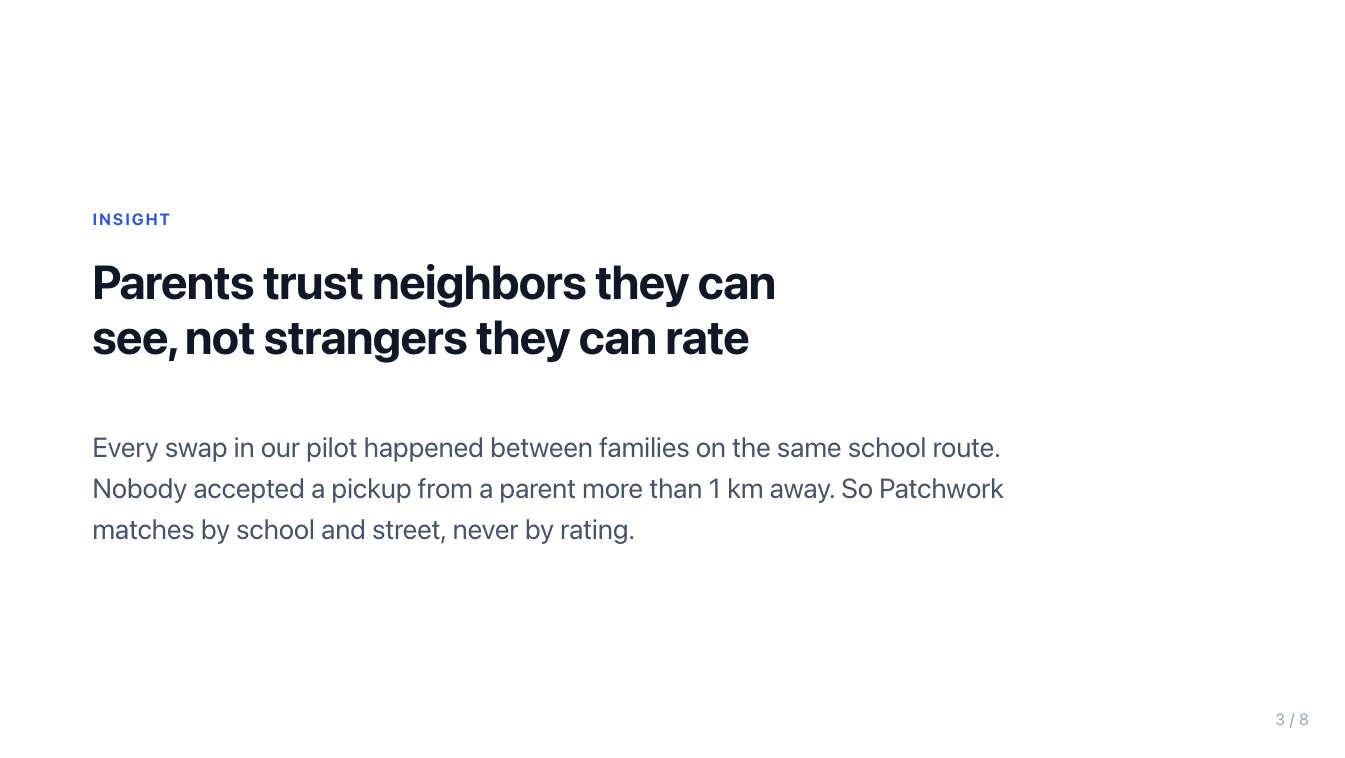
Open the pre-seed deck, eight slides for a consumer app with no revenue yet.
- The insight gets its own slide. "Parents trust neighbors they can see" explains the whole product, and why a babysitting marketplace is not the competitor.
- The early signal is small and honest: one school, six weeks, no marketing, 71% of families still active. It is measured, so it counts.
- The risks are named by the founders, each with how they will find out early. That saves ten minutes of questions.
Build an 8-slide pre-seed pitch deck and publish it on Birta as one web page with a link for every slide. Company: [what you do, for whom, in one sentence] Problem: [who has it, with one survey or interview number] Insight: [what you learned that others miss] Early signal: [pilot, waiting list or test, with numbers and dates] How it grows: [how one customer brings the next] Team: [names, one line each] Risks: [two risks and how you will test them] Ask: [amount, months, milestone, contact] Title every slide with its claim, not its topic. Use only my facts and list what is missing at the end.
Seed deck: first revenue, counted market
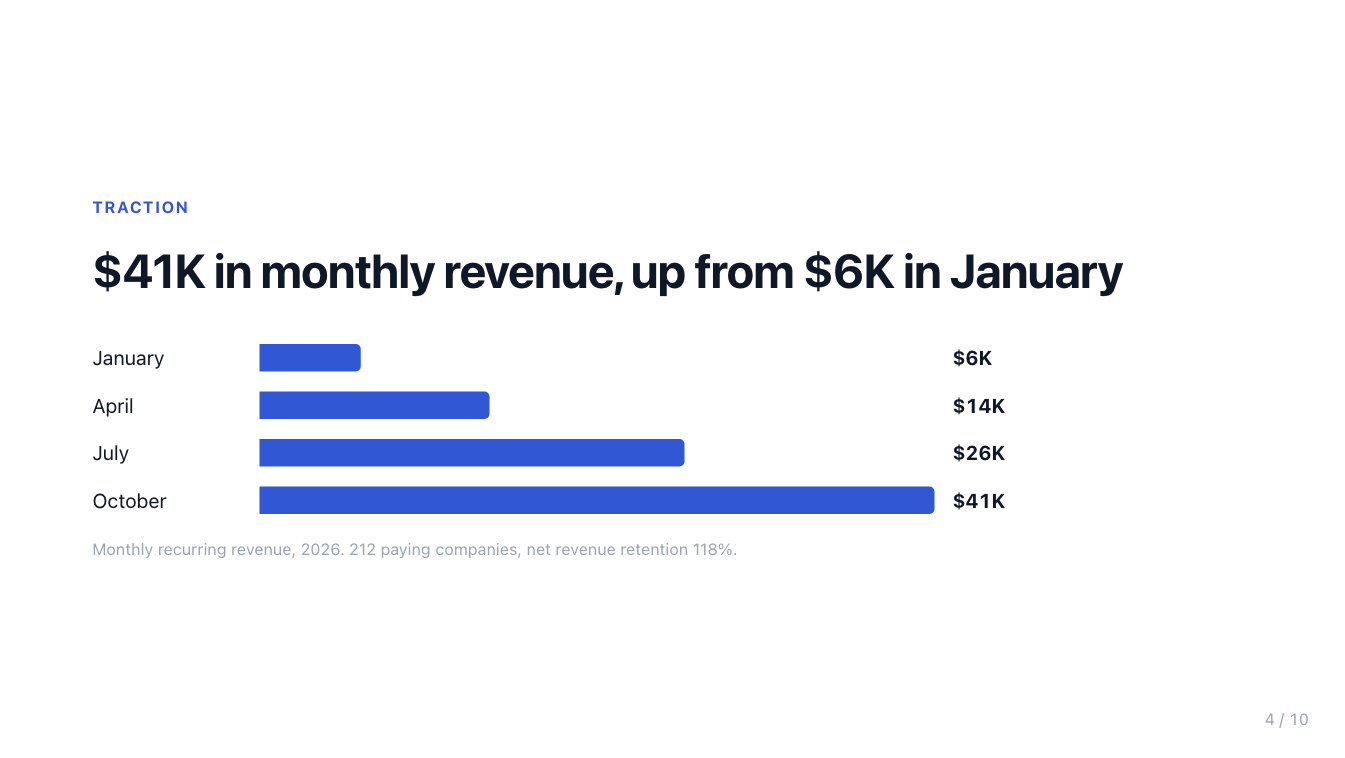
Open the seed deck, ten slides for a B2B startup with paying customers.
- The number is the title. "$41K in monthly revenue, up from $6K in January" says what the chart shows before anyone reads the bars.
- The market is counted from the bottom: 62,000 exporters times the $2,300 contract customers pay today. Every number on the slide can be checked.
- The ask names a milestone: $3M to reach 1,000 paying customers by a date, with the split of spending under it.
Build a 10-slide seed pitch deck and publish it on Birta as one web page with a link for every slide. Company: [what you do, for whom, with what result] Problem: [who loses what, with evidence] Solution: [how it works, in three steps] Traction: [revenue or users by month, retention, number of customers] Why now: [what changed recently] Market: [number of potential customers, your average price] Business model: [pricing, margin, cost to acquire a customer] Competition: [two alternatives and why customers switch] Team: [names, one line each] Ask: [amount, runway, milestone, use of funds, contact] Title every slide with its claim. Traction gets one bar chart. Use only my facts and list what is missing at the end.
Series A deck: metrics first
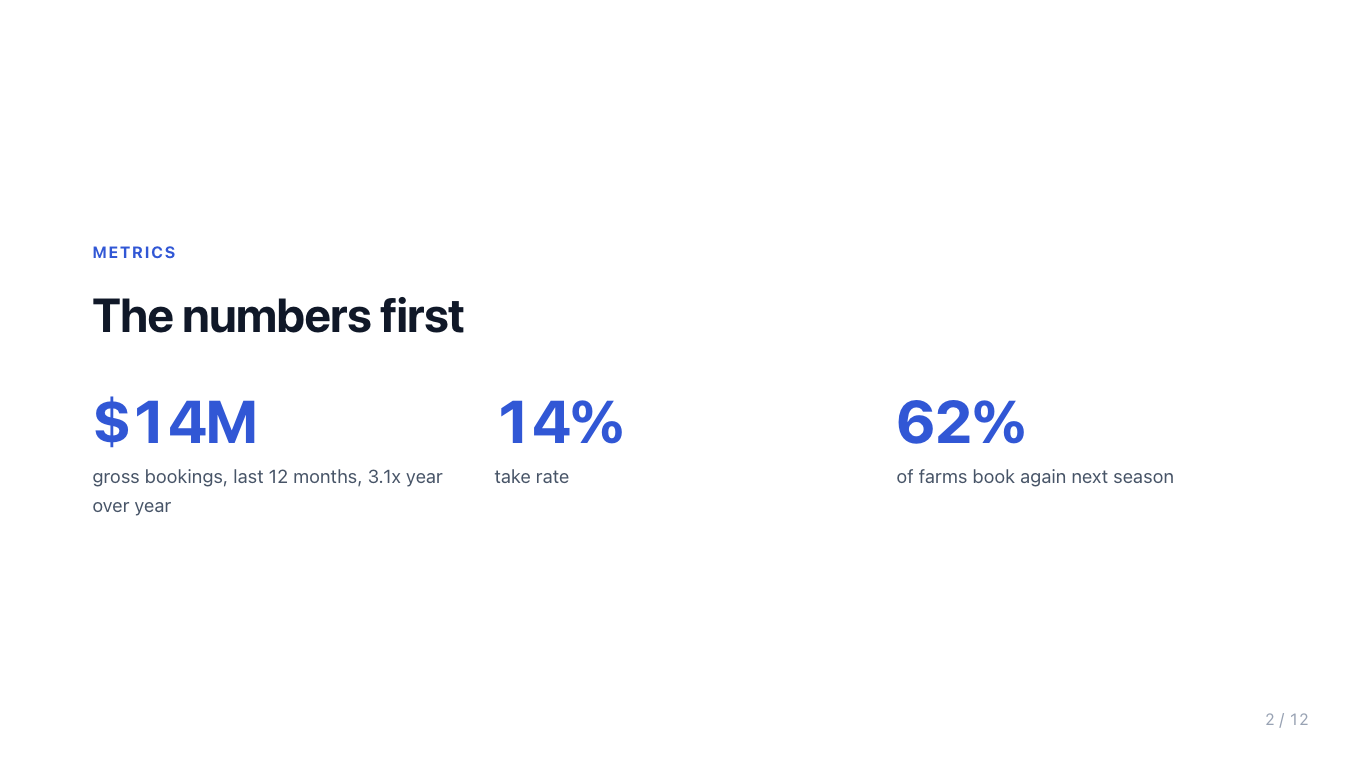
Open the Series A deck, twelve slides for a marketplace that is growing.
- Metrics are slide two. Bookings, take rate and repeat customers come before the problem, because a Series A investor decides on them first.
- Cohorts and unit economics get their own slides. Customers who spend more each year and a cost to acquire them that pays back in one season are the case for more capital.
- Use of funds is concrete: two regions, one product, working capital, in percentages.
Build a 12-slide Series A pitch deck and publish it on Birta as one web page with a link for every slide. Company: [what you do, in one sentence, with your headline number] Key metrics: [revenue or bookings, growth rate, retention or repeat rate] Problem and solution: [one slide each] Growth: [yearly or quarterly figures for a chart] Cohorts: [how customers from each year behave] Unit economics: [acquisition cost, contribution, payback] Market: [how big, how much of it you hold] Competition: [alternatives and why you win] Team: [names, one line each] Use of funds and ask: [amount, split, milestone, contact] Put the metrics on slide 2, right after the title. Title every slide with its claim. Use only my facts and list what is missing at the end.
What the classic decks teach
Most investor decks still follow the outline Sequoia Capital published for founders: company purpose, problem, solution, why now, market potential, competition, business model, team, financials and vision (Sequoia, "Writing a business plan"). The three decks above keep that order and add a traction slide, which is what most investors look for first. To start from the structure rather than from an example, the pitch deck template has all ten slides with what each one has to prove, as text and as a PowerPoint file.
After the agent builds it
You get a link. Check every number against your notes first: the prompts tell the agent to use only your facts and to list what is missing, so fill those gaps rather than letting it guess.
Then send the link. Each slide has its own address, so a follow-up can point straight at the ask. When the numbers change after a month of meetings, ask the agent for the next version: it goes to the same link, and nobody reads last month's attachment. For decks made inside Claude, the Claude slides guide shows how to get them out as a link too.
Make a deck like these
Paste your notes into Birta's chat. The agent builds the deck and gives you a link for every slide.