The ten slides, in order
An investor pitch deck runs ten to twelve slides: what the company does, the problem, the solution, traction, why now, the market, the business model, the competition, the team and the ask. Sequoia's business plan outline, the one most templates descend from, uses nearly the same list. The order matters less than one rule: every slide title states its claim. "Revenue grew from $6K to $41K a month" is a title; "Traction" is a label. Someone who reads only the titles should get the whole pitch.
Here is a seed deck built on this template, as a live page:
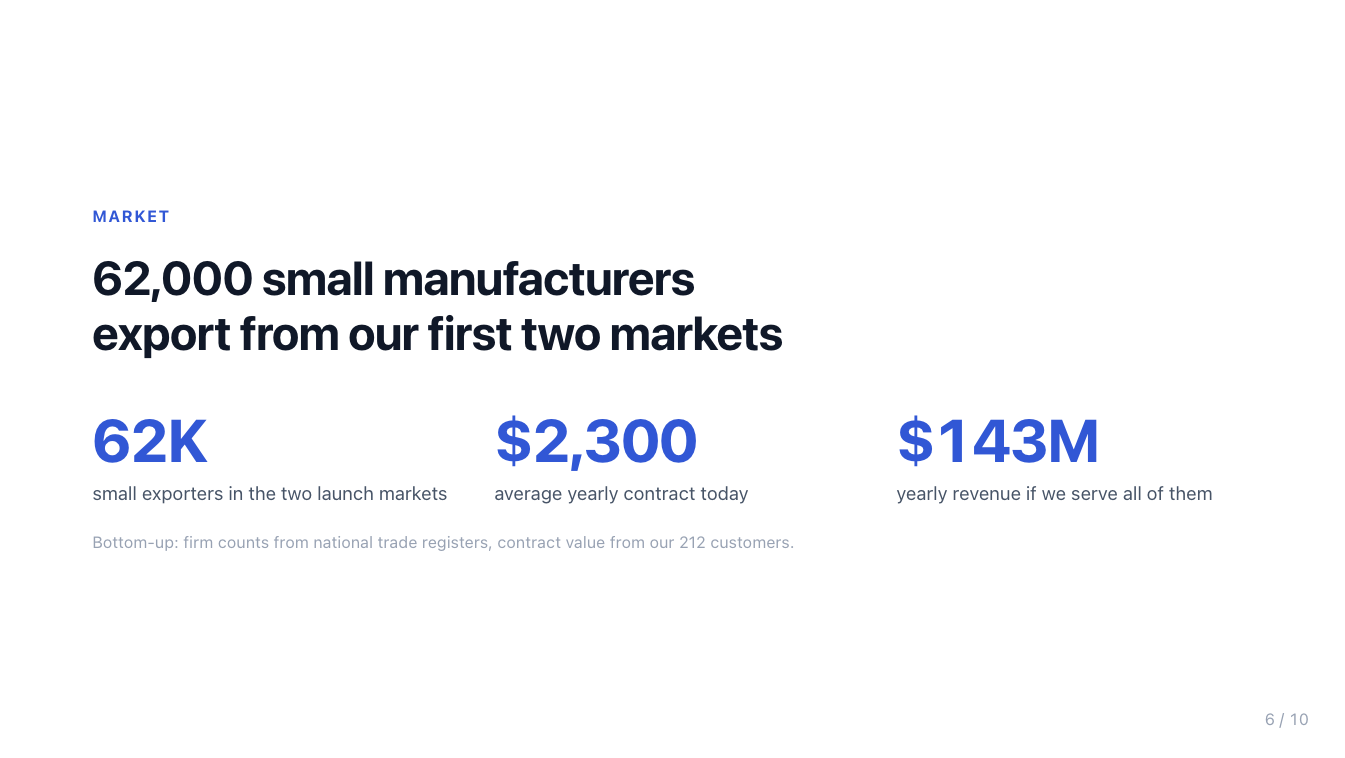
Open the example deck, then copy the template below.
The pitch deck template
1. COMPANY: [Company] [does what] for [whom], [with what result].
   Below it: how much you raise and the milestone it reaches.

2. PROBLEM: [Who] loses [time / money / customers] because [cause].
   Three lines of evidence: a number, an interview count, a quote.

3. SOLUTION: How [Company] removes the problem, in three steps.
   A screenshot or a short workflow, not a feature list.

4. TRACTION: [Metric] went from [X] to [Y] in [period].
   One chart. Name the metric: revenue, users, retention, pilots.

5. WHY NOW: What changed in the last two years that makes this possible.
   A regulation, a platform, a cost, a behavior.

6. MARKET: [Number] [customers] x [price] = [market size].
   Count bottom-up from customers you can name.

7. BUSINESS MODEL: Who pays, how much, how often.
   Margin, cost to acquire a customer, payback.

8. COMPETITION: What customers use today and why they would switch.
   Two or three alternatives, one line each.

9. TEAM: [Names, roles], one line each on why they can do this.

10. THE ASK: Raising [amount] for [months] to reach [milestone].
    Use of funds in three lines. Contact.
It is plain text, so it pastes into PowerPoint, Keynote, Google Slides or a chat with an agent. The design comes later; the claims on each slide come first. The same ten slides as a PowerPoint file, with the prompts as slide titles and the guidance in grey under each one, open in Keynote and Google Slides too:
Download as PowerPoint (.pptx)
What each slide has to prove
- Company. That you can say what you do in one sentence. If the sentence needs the word "platform", it is not finished.
- Problem. That the pain is real and costs someone money. Interviews count; "we believe" does not.
- Solution. That the product removes that specific problem. Show it working rather than listing what it can do.
- Traction. That people want it. Put the number in the title and the chart under it. Before revenue, use the strongest signal you have: a waiting list, a pilot, retention in a small test.
- Why now. That the timing is not an accident. Investors pass on good ideas that were equally possible ten years ago.
- Market. That the business can get big. A bottom-up count (customers times price) is more convincing than a top-down industry figure.
- Business model and competition. That the money works and that customers will move.
- Team. That these people, not others, will build it.
- The ask. An amount, a runway and a milestone. "Raising a seed round" is not an ask.
How the deck changes by stage
The slides stay; their weight moves.
- Pre-seed. Little or no revenue, so the problem, an insight nobody else has, an early signal and the team carry the deck. Eight slides can be enough.
- Seed. First revenue. Traction moves to slide four and the market is counted from real contract values.
- Series A. Metrics open the deck, right after the title: revenue or bookings, growth, retention, unit economics. The story follows once the reader trusts the numbers.
The pitch deck examples show one finished deck for each of these stages.
Fill it in from your notes
An agent turns the template into a deck in a few minutes if you give it the facts and the rules. Paste this into Birta's chat, or into the agent you already use with Birta connected:
Build a [number]-slide investor pitch deck for a [pre-seed / seed / Series A] round and publish it on Birta as one web page with a link for every slide. Slides, in this order: company, problem, solution, traction, why now, market, business model, competition, team, the ask. Title every slide with its claim, not its topic: "Revenue grew from $6K to $41K a month", not "Traction". Traction gets one chart. The market is counted bottom-up: number of customers times price. Use only the numbers in my notes. Where one is missing, leave a visible placeholder and list the gaps at the end. My notes: [paste: what you do, the problem and evidence, traction numbers, pricing, competitors, team, how much you raise and for what]
The gap list is the part to read first. A deck with "[ARR missing]" on slide four tells you what to find before the meeting, and that is better than a number the agent made up. The Claude slides guide covers the same job inside Claude, with its PowerPoint export.
Send it as a link, not an attachment
A deck sent before a meeting is read alone, usually on a phone, often forwarded to a partner. A web page suits that better than a file:
- It opens anywhere, without downloading a 20 MB PowerPoint.
- Each slide has an address, so a follow-up email can point at
#slide-10, the ask. - The next version goes to the same link. After the first meetings you change the traction slide, and everyone who has the link sees the new numbers instead of the attachment from last month.
Keep the PowerPoint for the conference laptop and for funds that ask for a file in their form.
Build your deck from your notes
Paste your notes into Birta's chat. The agent builds the deck and gives you a link for every slide.