
What a good executive summary example shows
An executive summary is read instead of the document behind it, by someone who has to decide something. A good example shows how that decision gets to the top: the headline states it, the numbers that support it come right after, and every next step has one owner and a date.
The four examples below summarize four kinds of document for four readers. Each is a live page you can open, scroll on a phone and leave a remark on. The companies and the numbers are made up; the numbers inside each example add up. Under each one is the prompt that makes one like it from your own document.
Report executive summary: a cost review that asks for a decision
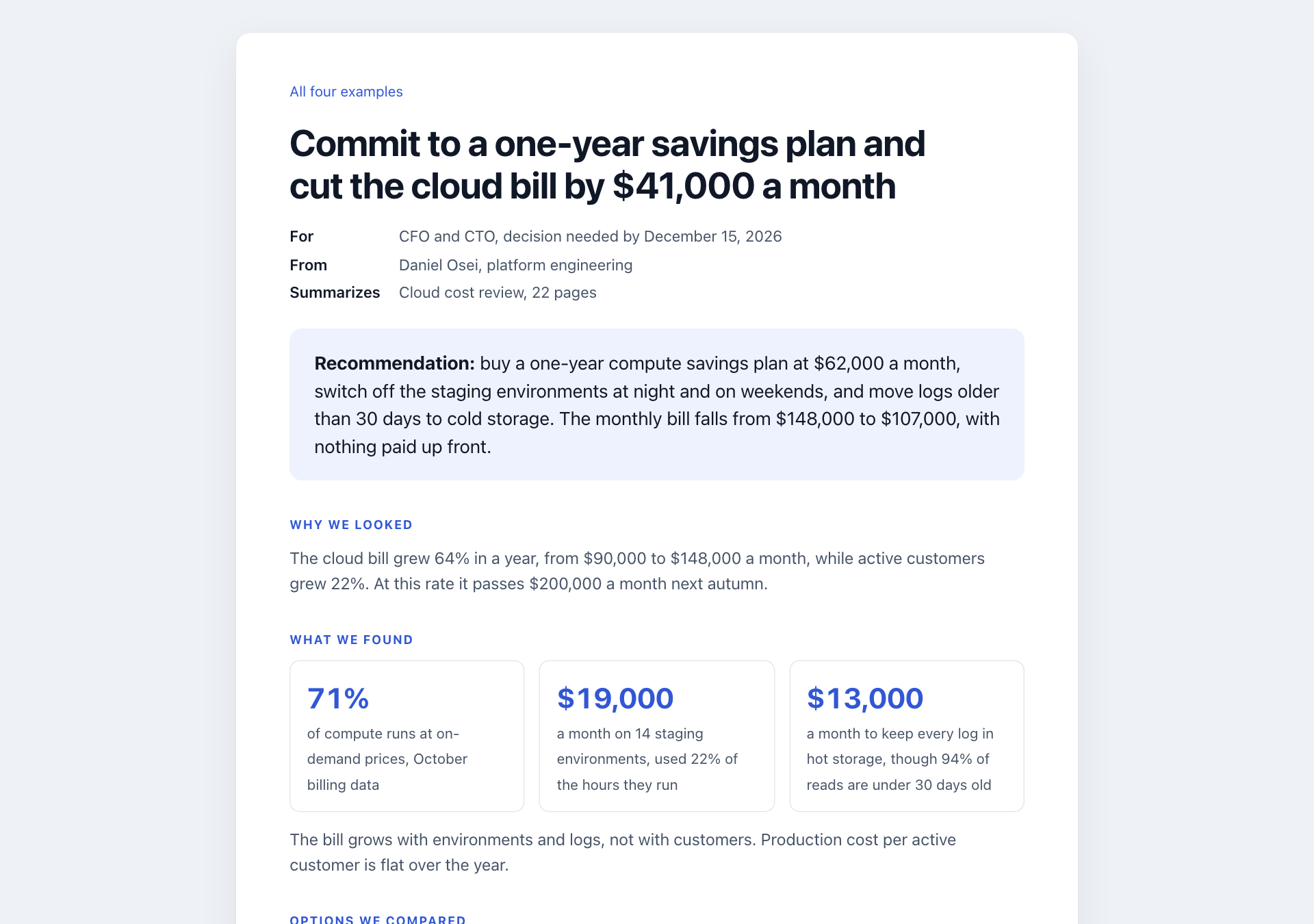
Open the report summary. The readers are a CFO and a CTO, and the document is a 22-page review of the cloud bill.
- The headline is the decision and its effect. "Cut the cloud bill by $41,000 a month" can be approved or refused; "Cloud cost review" cannot.
- The saving is broken into its parts. $16,000 plus $14,000 plus $11,000, so a reader who doubts one part can question it without rejecting the rest.
- The rejected options stay. The three-year plan saves more, and the summary says why it still loses. Without it, someone asks in the meeting.
Write an executive summary of the report below and publish it on Birta as a single page. Readers: [who decides, and what they care about most] Decision: [what I want them to approve] Format: a headline with the decision and its effect in money or time; who it is for, who wrote it, what it summarizes; the recommendation in one paragraph; why we looked in two sentences; three numbers with source and period; the options compared, including the rejected ones; cost and return; one or two risks with what we do about them; next steps with one owner and a date each. Use only facts from the report. If a number or an owner is missing, leave a visible placeholder and list the gaps at the end. Report: [paste the report or attach the file]
Business plan executive summary: the ask comes first
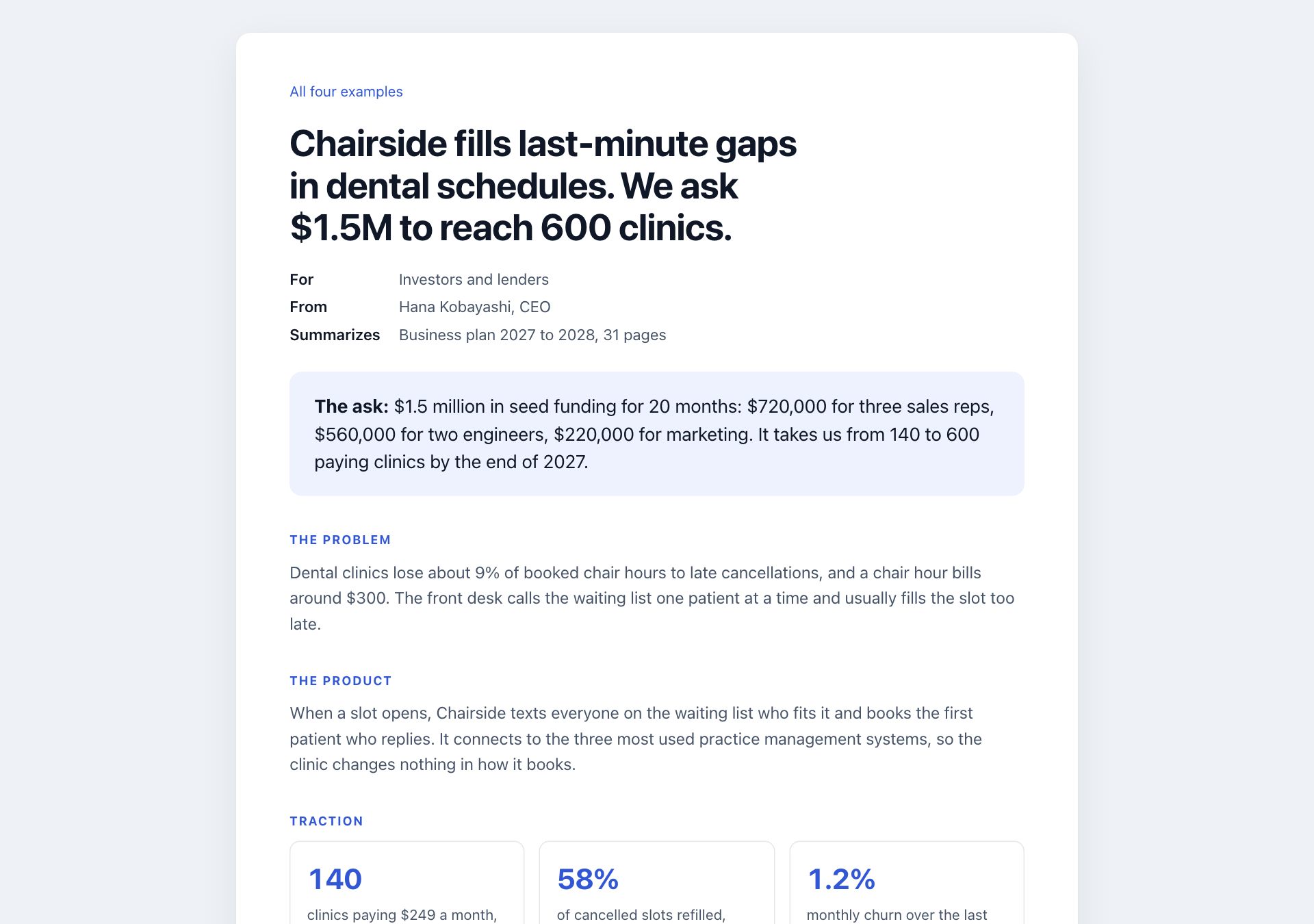
Open the business plan summary. The readers are investors and lenders, and the plan behind it runs to 31 pages.
- The ask is in the headline and in the first box. How much, for how long, and the three things it pays for, with amounts that add up to the total.
- Traction is measured, not promised. 140 paying clinics, 58% of cancelled slots refilled, 1.2% monthly churn. Projections come later and take one paragraph.
- The market is the part the company can reach. Clinics on the three systems it connects to, not every dentist in the country.
If the reader is an investor who will see the deck next, the pitch deck examples carry the same story over ten slides or so.
Write the executive summary of my business plan and publish it on Birta as a single page. Company: [name, what it does in one sentence] Ask: [amount, runway, what it pays for with amounts] Problem and product: [who has the problem, what it costs them, how the product solves it] Traction: [customers, revenue, retention, anything measured] Market: [the part of the market you can reach, and how you counted it] Team: [names, one line of record each] Financials: [revenue for the next two years, break-even] Order: headline with the ask, the ask with use of funds, problem, product, traction, market, team, financials, next steps. Use only my facts and tell me what is missing.
Proposal executive summary: the client's problem in their words
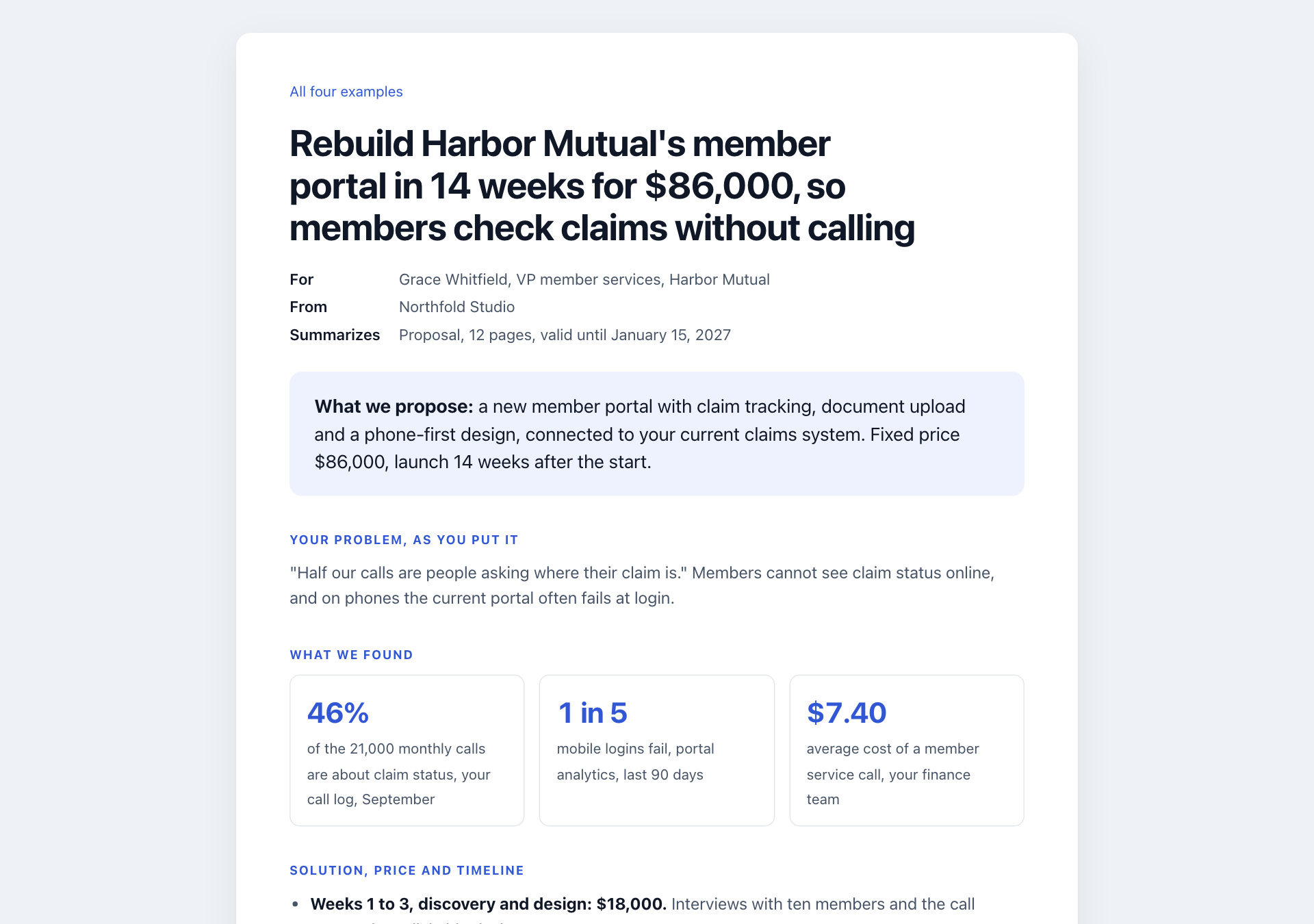
Open the proposal summary. The reader is the client's VP, who approves the money and forwards the rest of the proposal to IT.
- It quotes the client. "Half our calls are people asking where their claim is" is the problem as the buyer said it, so the solution reads as an answer.
- The numbers are the client's own. Call volume, failed logins and cost per call come from their data, which makes the return hard to argue with.
- The last section is what the client must do. Sign by a date, give API access, name one person for reviews. A proposal that ends with the price leaves the next step to the client.
The full document this summarizes follows the business proposal template.
Write the executive summary of my proposal and publish it on Birta as a single page. Client: [company, who approves, what they told us the problem is, in their words] Their numbers: [what we measured or they gave us] Solution: [what we build or do, in phases with prices] Timeline: [weeks or dates] Return: [what the client saves or gains, and how you calculated it] What we need from the client: [approvals, access, people, with dates] Order: headline with what, how long and how much; the proposal in one paragraph; the client's problem quoted; three numbers; phases with prices; return; one risk; what we need from the client. Use only my facts and tell me what is missing.
Project executive summary: results against goals
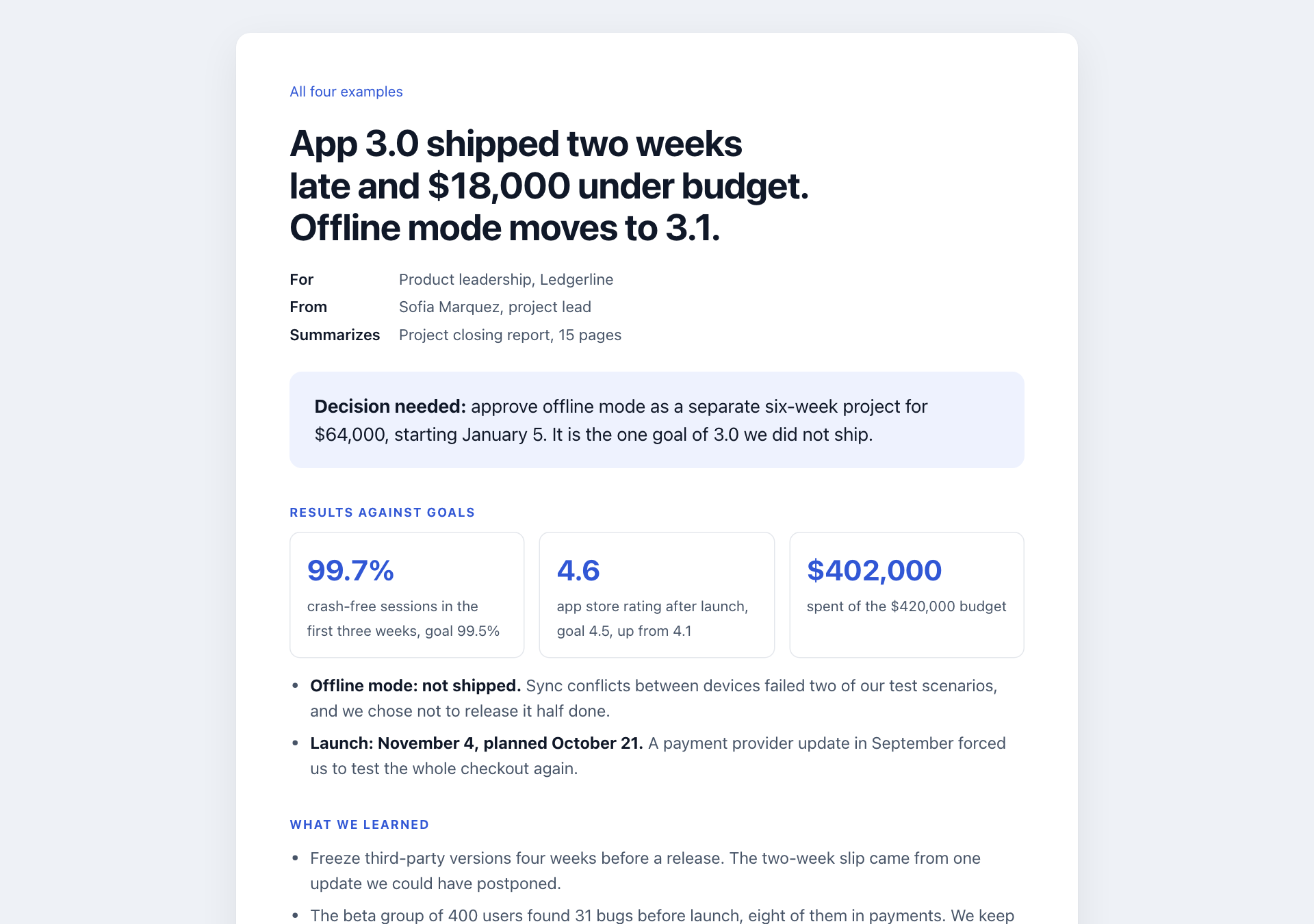
Open the project summary. The readers are the product leadership, and the document is the closing report of an app release.
- The headline gives the bad news with the good. Two weeks late and under budget, with the goal that was missed named in the same line.
- Every result sits next to its goal. 99.7% against a goal of 99.5% reads in a second; a number without its goal needs explaining.
- It still asks for a decision. A project summary that only reports gets filed; this one asks to fund the missing feature as its own project.
For a summary sent every week while the project runs, use a project status report instead.
Write an executive summary of this project report and publish it on Birta as a single page. Project: [name, what it was meant to deliver] Goals and results: [each goal with its target and what we reached] Budget and schedule: [planned against actual, and the main cause of any gap] What was not done: [and why] Decision needed: [what leadership should approve next] Order: headline with the outcome and the main gap; the decision needed; results against goals; what we learned; risks; next steps with one owner and a date each. Use only facts from the report and list anything missing.
What the four have in common
- A decision in the first line. Approve a plan, fund a round, sign a proposal, start the next project.
- Three numbers, each with its source. Enough to trust the decision, with the rest left in the full document.
- Steps with one owner and a date. "The team will follow up" is not a step.
The blank structure behind all four, with a version for each kind of document, is in the executive summary template, also as a Word file:
Download the template as Word (.docx)
After the agent writes it
Each summary is a web page with its own address, so it opens on a phone without a download. A reader who questions a number leaves a remark on that line, without an account. You ask the agent to work through the remarks, and the revised summary goes to the same link, so nobody approves from an old attachment.
Turn your document into a summary
Paste the report, plan or proposal into Birta's chat. The agent writes the summary and gives you a link to send.