
What a good one-pager does
A one-pager gives one reader what they need for one decision, on a single page. An investor decides whether to take a call. A buyer decides whether to try the product. A manager decides whether to fund the project. Everything on the page serves that decision, and the rest is left out.
The five examples below are built that way. Each is a live page, not a screenshot of someone's PDF: open it, scroll it on your phone, leave a remark on any line. The companies and the numbers are made up; the structures are the ones that work.
Under each example is the prompt that makes one like it. Copy it, replace the brackets with your facts, and paste it into Birta's chat or into the agent you already use with Birta connected.
Startup one-pager: one ask to an investor
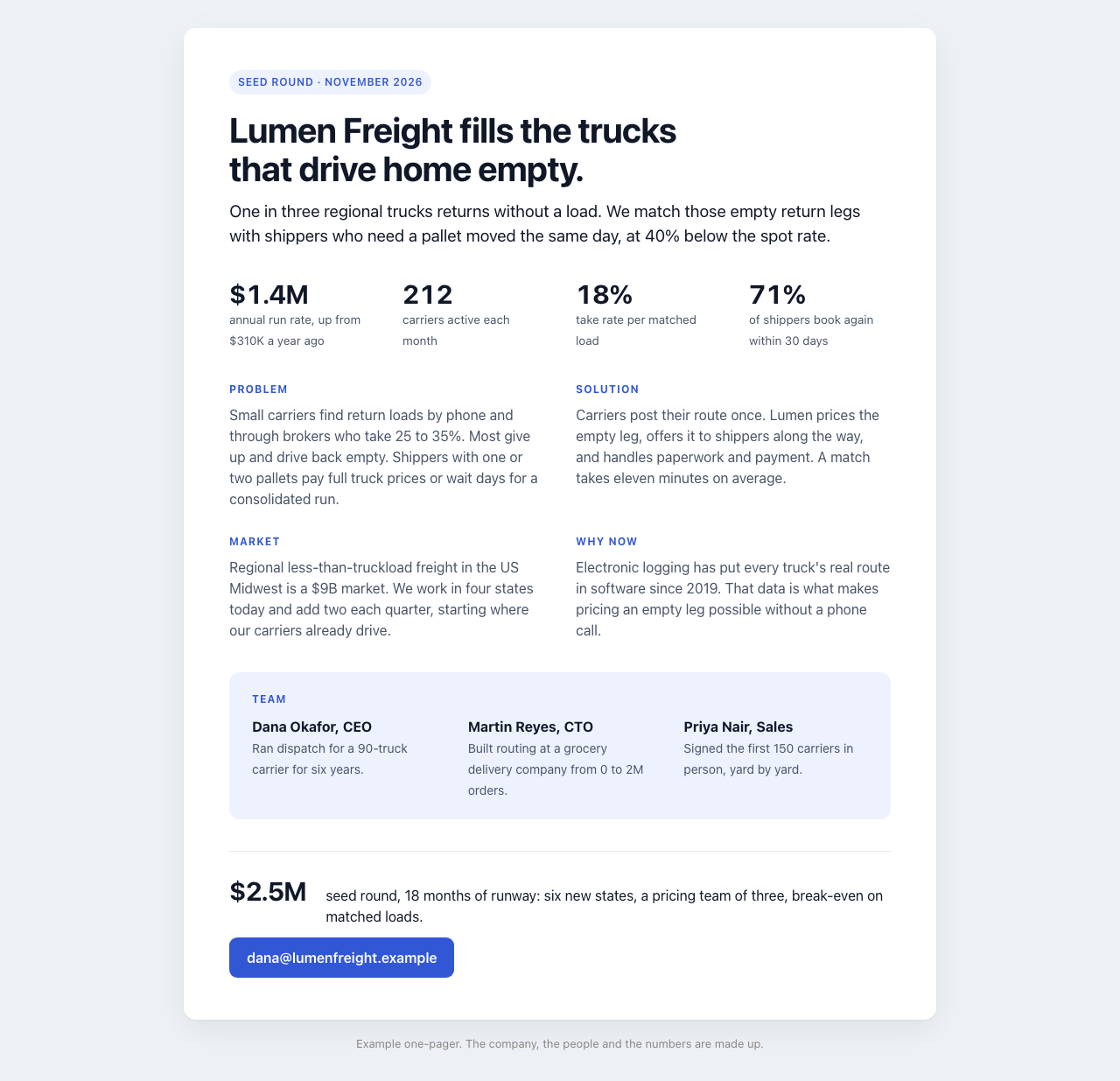
Open the startup one-pager. The reader is an investor with forty of these in the inbox.
- The headline is the pitch. "Fills the trucks that drive home empty" says what the company does without the word "platform".
- Traction comes before the story. Four numbers sit right under the pitch, because an investor looks for them first.
- The ask is a number with a plan. $2.5M, 18 months, three things it pays for.
The one-pager gets the meeting; the deck carries it. The pitch deck examples follow the same order over ten slides or so, one deck per funding stage.
Write a startup one-pager for investors and publish it on Birta as a single page. Company: [name, what it does in one sentence] Traction: [revenue or users, growth, retention, anything measured] Problem and solution: [who has the problem, how you solve it] Market and timing: [market size, why now] Team: [names, one line of record each] Ask: [amount, runway, what it pays for] Contact: [name, email] Order: headline pitch, four traction numbers, problem, solution, market, why now, team, the ask. Keep every section under four lines. It must fit one page and read well on a phone. Use only my facts and tell me what is missing.
Product one-pager: a reason to try it
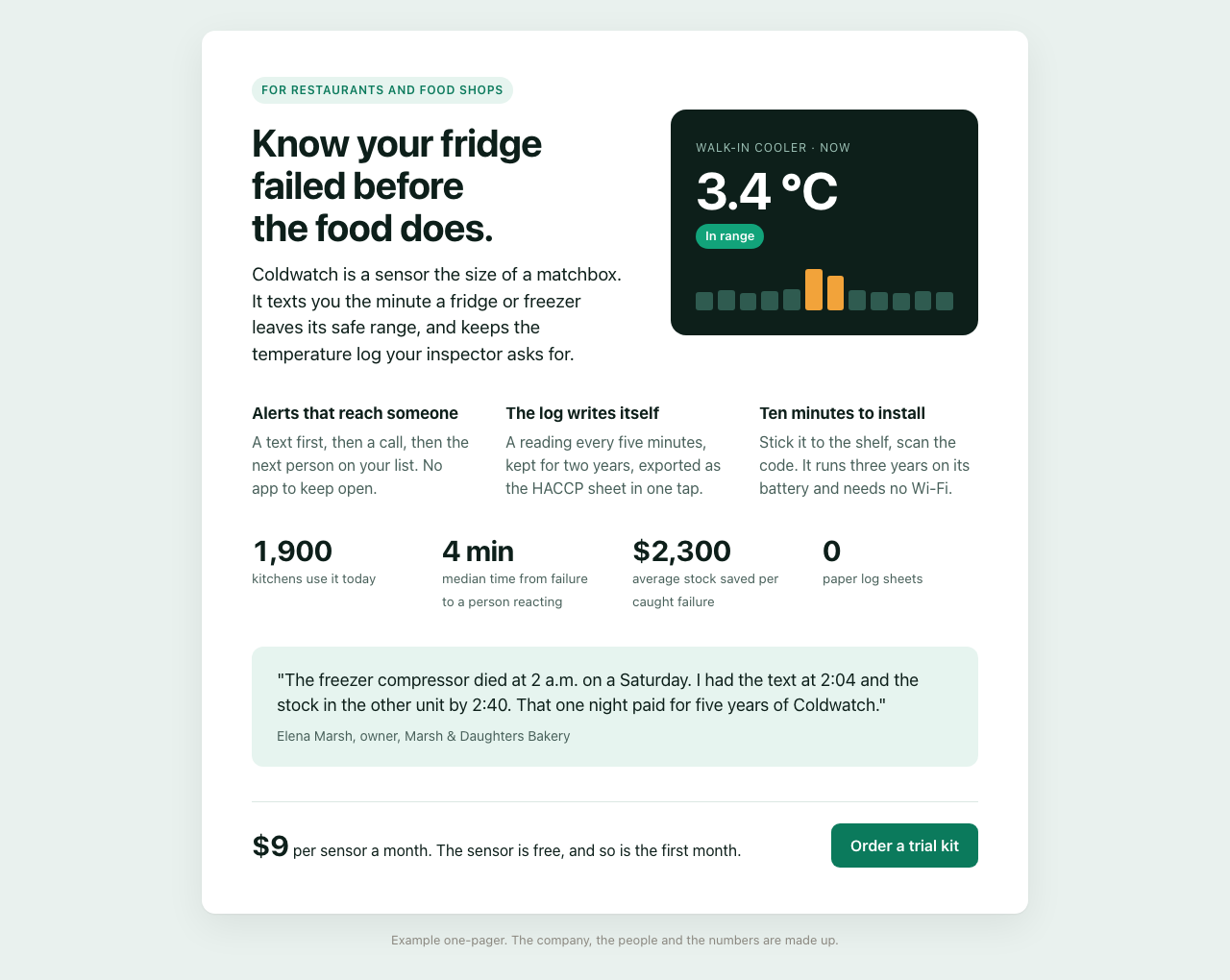
Open the product one-pager. The reader is a restaurant owner who has never heard of the product.
- It opens with the bad night, not the device. "Know your fridge failed before the food does" is the value proposition in the buyer's words.
- Benefits, then proof. Three things it does, four numbers, one customer quote with a time and a place in it.
- The price is on the page. A buyer who has to ask for the price usually does not.
Write a product one-pager for buyers and publish it on Birta as a single page. Product: [name, what it is] Buyer: [who buys it and the bad day it prevents] What it does: [three things, in the buyer's words] Proof: [numbers customers got, one customer quote with name and company] Price: [price and what is included] Next step: [trial, demo or order, and the contact] Order: headline about the buyer's problem, two-sentence summary, three benefits, four numbers, the quote, price and the next step. It must fit one page and read well on a phone. Use only my facts and tell me what is missing.
Company one-pager: who you are in a minute
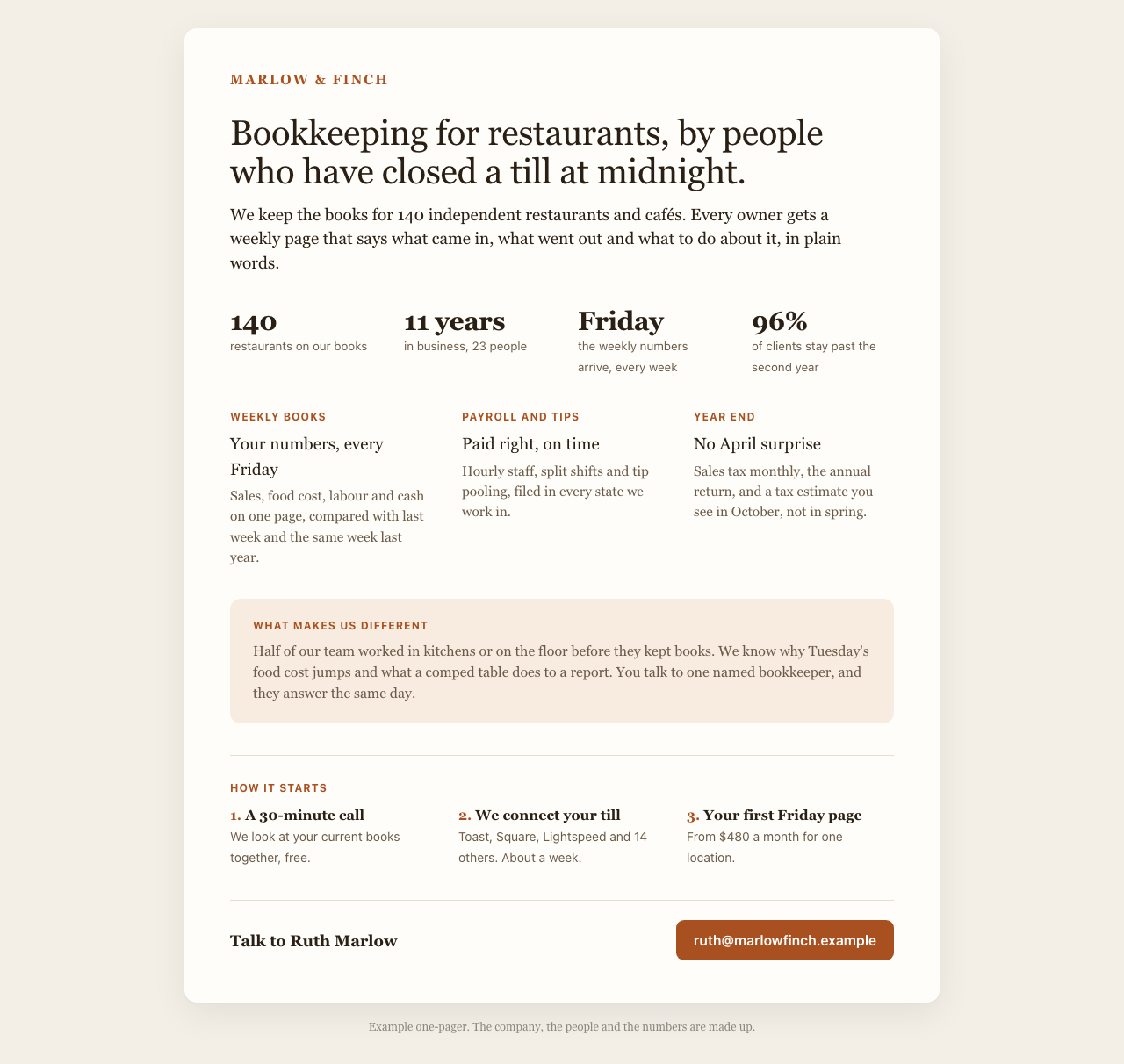
Open the company one-pager. The reader was sent your way by someone and wants to know whether you fit.
- One sentence carries the niche: bookkeeping, for restaurants, by people who worked in them.
- Services are named by what the client gets, "Your numbers, every Friday", not by the department that does the work.
- It ends with how to start and what it costs, with one named person to write to.
Write a company one-pager and publish it on Birta as a single page. Company: [name, what you do and for whom, in one sentence] Facts: [clients, years, team size, one number you are proud of] Services: [three services and what the client gets from each] Why us: [what you do differently] How to start: [first step, timing, starting price] Contact: [one named person, email] Order: one-sentence introduction, four facts, three services, what makes us different, how it starts, contact. It must fit one page and read well on a phone. Use only my facts and tell me what is missing.
Project one-pager: a decision from your own team
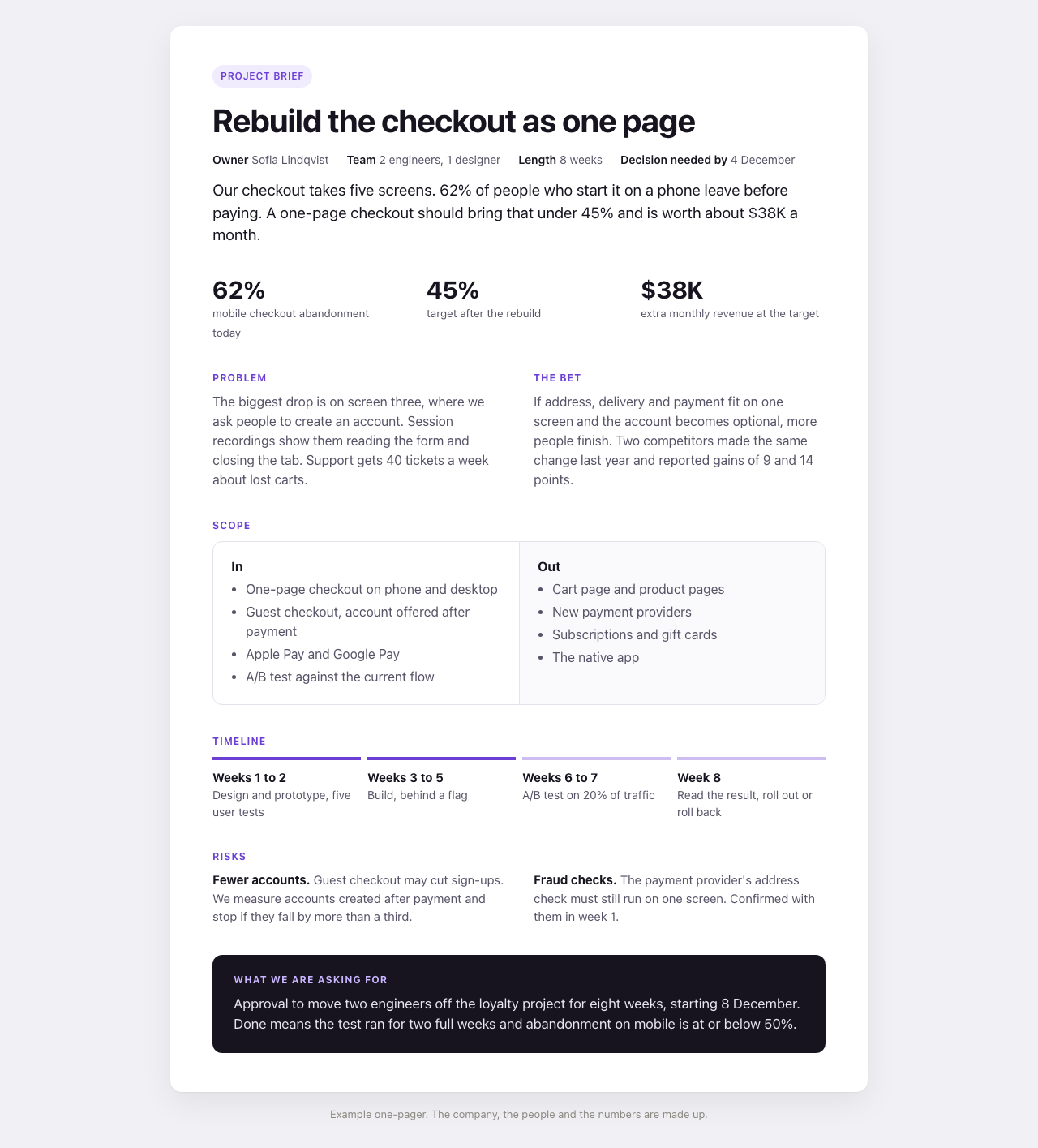
Open the project one-pager. The reader is a stakeholder who has to say yes or no to eight weeks of work.
- Scope has an "out" column. Listing what the project will not touch prevents more arguments than the plan itself.
- Risks come with a stop rule: what gets measured and at what number the team rolls back.
- The last block is the ask: who is needed, from when, and what "done" means.
Write a project one-pager for a decision and publish it on Birta as a single page. Project: [what you propose, in one line] Owner, team, length, decision date: [fill in] Problem: [what goes wrong today, with numbers] The bet: [why this change should work] Scope: [what is in, what is out] Timeline: [three or four phases] Risks: [each with what you measure and when you stop] Ask: [people, budget, start date, what "done" means] Order: title and summary with the numbers, problem, the bet, scope in two columns, timeline, risks, the ask last. It must fit one page and read well on a phone. Use only my facts and tell me what is missing.
Executive summary: the recommendation first
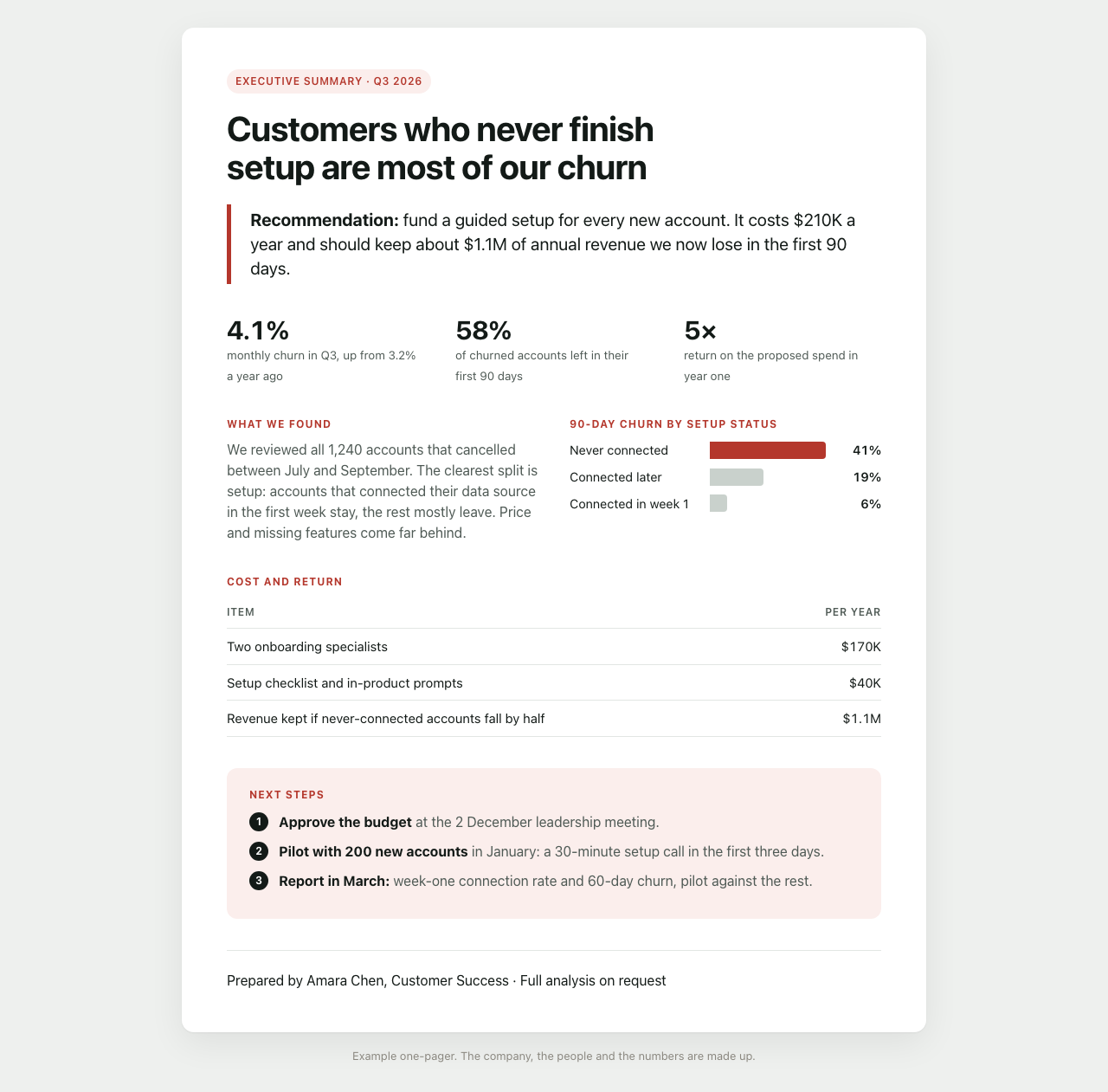
Open the executive summary. The reader is a leadership team with ten minutes for the topic.
- The recommendation is the second line, with its cost and its return. Someone who stops reading there still knows what is being asked.
- One chart, the one that makes the case. The full analysis is offered, not attached.
- Next steps have dates and owners, so the page ends in a decision and not a discussion.
Write a one-page executive summary and publish it on Birta as a single page. Recommendation: [what you ask the reader to decide, with cost and return] Findings: [what you looked at and the main result] Key numbers: [three figures, and the data for one chart] Cost and return: [line items] Next steps: [three steps with dates and owners] Prepared by: [name, team] Order: the recommendation first, three numbers, the finding with one simple chart, cost and return, next steps. It must fit one page and read well on a phone. Use only my facts and tell me what is missing.
An executive summary and a one-pager are not always the same thing. An executive summary condenses a longer document and can run past one page; a one-pager stands on its own and is usually more visual, as Zapier's guide puts it. This example is both: a summary kept to one page. For the summary of a long report or plan, use the executive summary template, or start from one of the executive summary examples for a report, a business plan, a proposal and a project.
After the agent builds it
You get a link. Check the numbers against your notes first: the prompts tell the agent to use only your facts and to name what is missing, so fill those gaps instead of letting it guess.
Then send the link. Whoever opens it can point at a line and leave a remark there, no account needed. Ask the agent to work through the remarks and it publishes the next version at the same address.
To write the content yourself first, the one-pager template has the structure to copy.
Make a one-pager like these
Give Birta's agent your notes and the reader. You get a page to send as a link, and people comment right on it.