What goes on a one-pager
A one-pager has five parts, in this order: a headline that says what you do or what you propose, the problem, your answer to it, proof, and one ask. It is written for one reader and one decision, and it fits one page. If it needs a second page, something on it belongs in another document.
Here is that structure filled in for a made-up startup, as a live page:
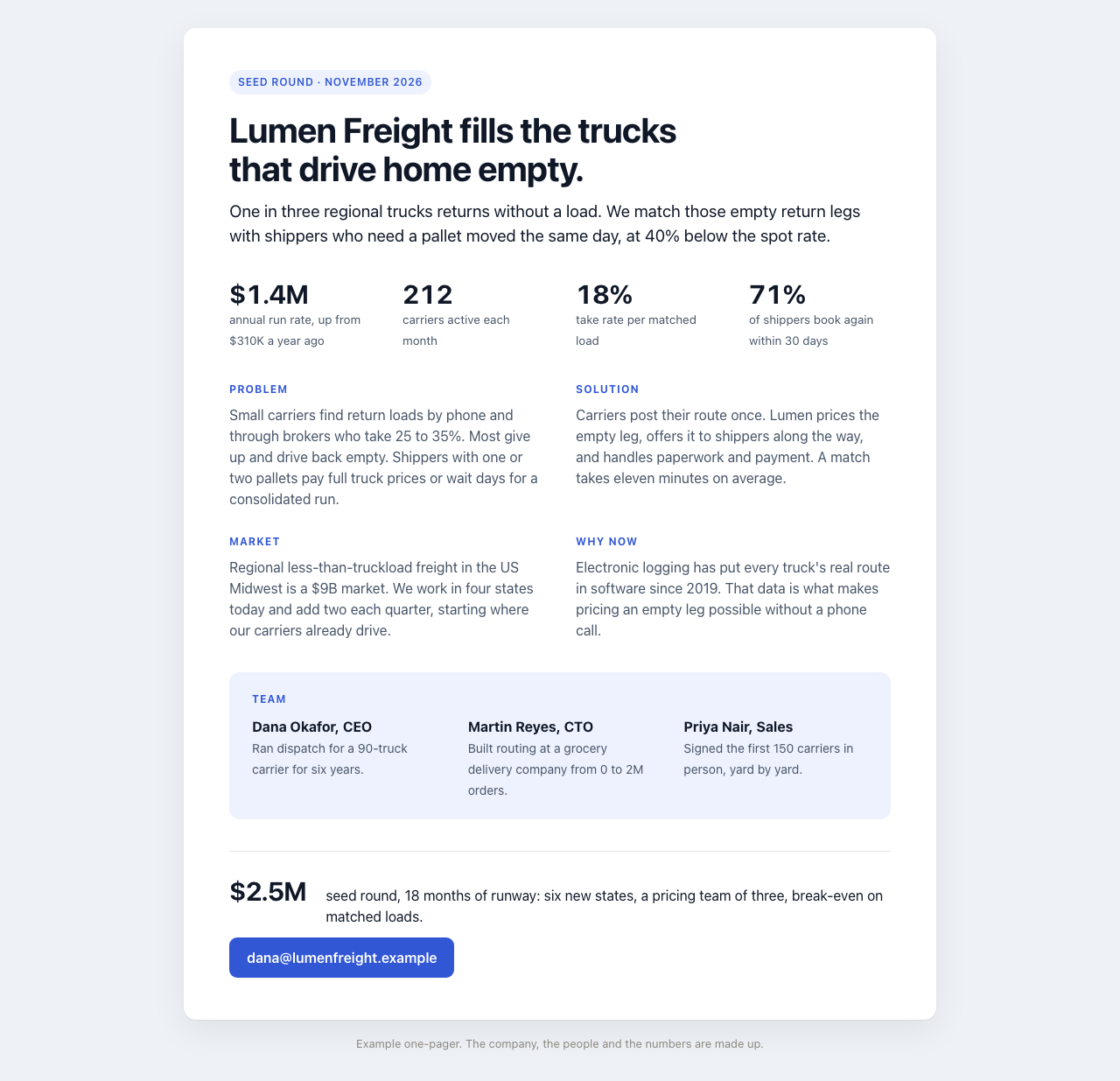
Open the finished one-pager, then copy the template below and fill it with your own facts.
The one-pager template
[HEADLINE] What you do or what you propose, in one sentence the reader would say.

[SUMMARY] Two sentences: who it is for and what changes for them.

[NUMBERS] Three or four figures that prove it is real.
- [number] [what it measures]
- [number] [what it measures]
- [number] [what it measures]

[PROBLEM] What goes wrong today, for whom, and what it costs them.

[SOLUTION] What you do about it and how it works, without jargon.

[PROOF] A customer, a result, a comparison, or the team's record.

[ASK] The one thing you want from the reader, with a date or an amount.

[CONTACT] One name, one way to reach them.
Paste it into any document, or give it to an agent that lays it out as a page (the prompt is further down). The same template as a Word file, with the parts as headings, opens in Word and in Google Docs:
How to fill in each part
- Headline. Write it last. If it could sit on a competitor's page unchanged, it is too general.
- Summary. Name the reader's situation, not your category. "For restaurants that keep temperature logs on paper" beats "an IoT platform".
- Numbers. Each needs a unit and a meaning: "71% of shippers book again within 30 days", not "71% retention". No numbers yet? Use facts: a signed pilot, a waiting list, years in the field.
- Problem and solution. Four lines each at most. Give the problem a cost in money or hours.
- Proof. One specific customer story is stronger than three adjectives.
- Ask. One. A one-pager that asks for a meeting, feedback and an introduction gets none of them.
Three versions of the template
The five parts stay; what fills them changes with the reader.
- Startup, for an investor. Numbers are traction: revenue, growth, retention. Add the market size and the team. The ask is the round: how much, for how long, what it pays for. If the investor takes the call, a deck follows: the pitch deck template has its ten slides.
- Product, for a buyer. The headline is the buyer's bad day. Numbers are results customers got. Add the price. The ask is a trial or a demo. Once a buyer asks for terms, the next document is a business proposal with scope, timeline and priced options.
- Project, for your own team. The headline is the change you propose. Numbers are the current state and the target. Add scope (in and out), a timeline and risks. The ask is the decision: people, budget, start date. Once the meeting decides, the owners and dates go into meeting notes, and progress after the start goes into a project status report.
All three are finished in the one-pager examples, together with a company overview and an executive summary. A summary of a longer report follows its own order, recommendation first: see the executive summary template.
Fill it in with an agent
The slow part of a one-pager is cutting, and an agent cuts well when it knows the reader. Paste the filled template, or just your raw notes, into Birta's chat or into the agent you already use with Birta connected:
Turn the notes below into a one-pager and publish it on Birta as a single page. Reader: [who reads it and what they decide] Structure: headline, two-sentence summary, three or four numbers, problem, solution, proof, one ask, contact. Keep every section under four lines. It must fit one page and read well on a phone. Use only the facts in my notes and tell me what is missing. Notes: [paste the template you filled in, or your notes]
The last instruction matters. An agent that lacks a number will otherwise invent one, and a one-pager with an invented number is worse than one with a gap.
Send it as a link
The result is a web page with its own address. That is not a PDF or a slide, and for a one-pager it helps:
- It opens on a phone without a download, which is where a forwarded one-pager is usually read.
- Readers answer on the page. They point at a line and leave a remark there, no account needed.
- You fix it in place. Ask the agent to work through the remarks; the next version is at the same address, so the link you already sent stays current.
If someone needs paper, print the page from the browser. Tell the agent it has to fit one printed sheet; the example above does.
Turn the template into a page
Paste your notes in Birta's chat. The agent writes the one-pager and gives you a link people can comment on.